
Redemption Song
What a book burned by the Nazis might have to tell us about politics today

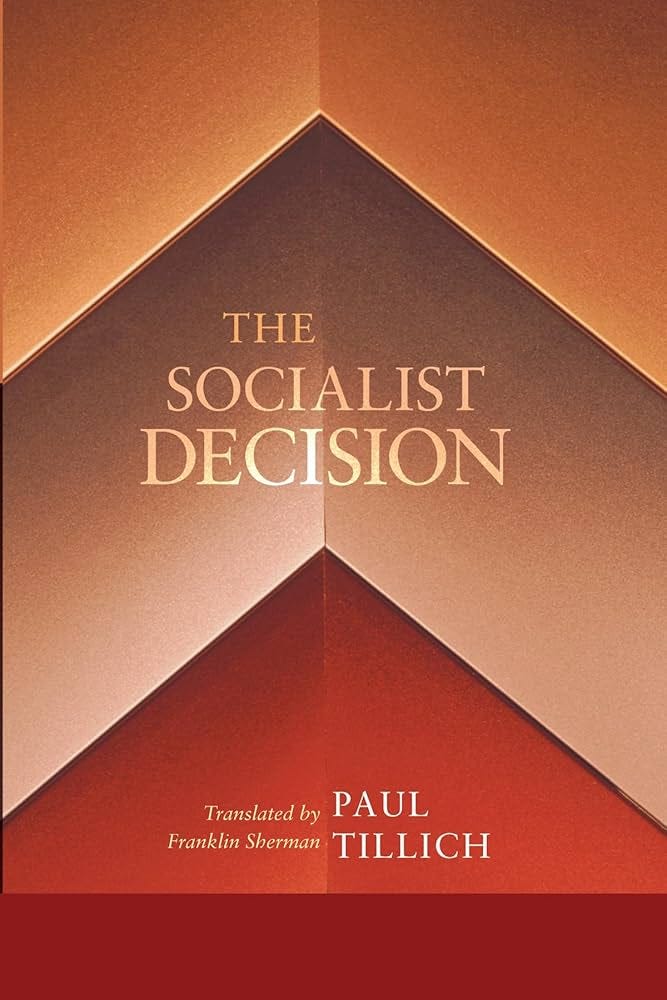
Maybe the worst thing about book-burning is that sometimes, it works. This was certainly the case in 1933 when the newly ascendant Nazis snuffed out the most important largely-unread socialist text of the 20th century, The Socialist Decision, by the Christian existentialist Paul Tillich, who then entered his American exile. Conventional wisdom is that Tillich’s American period was less political than his German work. Those who criticize him for this tend to ignore not only the continued favourable references in his writings to both socialism and, although more critically, to Marxism, all through the years of the early Cold War till his death in 1965 — they also tend to ignore the very human aspect of a person’s political exhaustion after first experiencing total moral, psychological, and religious collapse in the trenches of his country’s defeat in the first World War, and then, after having spent the interwar years working closely with Jewish socialists and strongly emphasizing the Jewish roots of the Christian faith and the pernicious dangers of antisemitism, as well as writing a searing diagnosis of the appeals and perils of fascism and the indispensability but ultimate inadequacy of liberalism to confront it, seeing his country defeated again, this time totally, and only after first descending into the murderous barbarism of the Shoah. The Socialist Decision remained the book of which Tillich was most proud.
This week, the progressive American Christian podcaster and educator Tripp Fuller has written and published a substantial and for the most part excellent audio summary of The Socialist Decision, and its relevance to the contemporary American situation, on his Substack. I would strongly encourage you to check it out. Fuller’s applications of Tillich’s analysis to Trump’s USA are apt, and his theological elaborations on Tillich, including a very beautiful framing of the Incarnation, are deeply moving. But quite naturally, his essay is aimed towards an American, religious (and specifically Christian) audience. So from my perch as a Canadian Anglo-Catholic social democrat in a multi-faith and secular political orbit, I wanted to respond with a supplementary piece offering some relevant insights from Tillich for those operating outside of the United States or the Church.

Perhaps the most American aspect of Fuller’s essay is that it doesn’t fully disentangle liberalism and socialism in Tillich’s political schema — which, in fairness, has in recent years become more than just an American problem. In fact, the relationship — or lack of one — between liberalism and the populist blue collar constituencies who are supposedly meant to make up the ranks of the world’s socialists has in some ways become one of the greatest political anxieties of our times.
As Fuller notes, Tillich basically identifies the root of all political thought and action in the existential categories of origin and demand (there are shades here of what will emerge as the polarity of destiny and freedom in his later Systematic Theology). Basically, origin is where we come from (family, language, nation, authority etc.), demand is what we’re going to (justice, creativity, plenitude, etc.). Roughly speaking, conservative instincts flow from the powers of origin, and liberal democratic and socialist movements draw power from demand. But the latter do so in a contradictory way.
Demand presents as a criticism of origin: the family is patriarchal and authoritarian; the nation is exclusive and imperialist; the language codifies relationships of power. This is why the bourgeoisie, in the early days of capitalism, was a revolutionary force albeit a funny sort of one; why Marx and Engels wrote, in the Communist Manifesto, that “[t]he bourgeoisie wherever it has got the upper hand, has put an end to all feudal, patriarchal, idyllic relations.” To put it crudely: purple does not remain a colour that only royalty can wear in a society where textile manufacturers and producers of synthetic dyes can make any money selling purple t-shirts. According to Tillich, this liberal instinct, what he calls the bourgeois principle, drains the world of its sacred qualities and reduces everything to a commodity.
For the capitalist, this is liberating. For the worker (or the colonized, or the otherwise oppressed) it is a liberation of a different sort — like being cut free from the ropes binding you to a chair that was being tipped over a canyon. Tillich’s words in 1933 are chillingly prescient in their description of our post-neoliberal world: “Liberalism prevails, in bourgeois society, among the groups that require the free play of forces in their development, and for whom the idea of harmony provides justification for their unlimited economic aspirations […] the Enlightenment’s paradoxical concept of harmony is being more and more transformed into the feudal, stratified concept of organism espoused by political romanticism [i.e. fascism]. This is the way from liberalism to the new feudalism.” The emphasis was Tillich’s.
93 years ago, Paul Tillich explained clinically why working class people, denied a meaningful socialist choice, would be drawn instead not to a centrist liberal half-measure but to socialism’s seeming antipode of right-wing barbarism. And nobody’s read it because it was one of the first books the barbarians threw on the fire.
Since 2016 at least, but perhaps as far back as Thomas Frank’s What’s The Matter With Kansas? (2004), observers have been declaiming — with an air of either incredulity, triumph, or resignation — that working-class voters are ‘economically left-wing, socially right-wing,’ or ‘economically progressive, socially conservative.’ But in 1933, Tillich not only anticipated this analysis, but sought a way out from it. For Tillich, socialism’s participation in the critique of conservative origin offered by liberalism was not optional — this is what made it part of the democratic tendency in human life, part of the existential movement towards the demand. But its role within or over against liberalism was contradictory. Why? “Socialism is prophetism on the soil of an autonomous, self-sufficient world.” What does this mean?
In the process during which capitalism replaces human awe and wonder towards the world with what Tillich calls “technical reason” — a process with huge upsides (hooray penicillin!) but which also robs all sacred meaning out of reality in order to objectify commodities for exploitation and sale — the market inevitably turns to the labour of human beings themselves. When the bourgeois principle attempts to commodify labour, whether in enslaved or exploited waged work, it tries to objectify that which most profoundly resists objectification: the subjective par excellence, the human person. “There remains an element of proletarian being which has not been reduced to the status of a thing, and from this element there emerges the struggle against the bourgeois principle,” he writes. I should say here that Tillich employs a more expansive use of the term “proletarian” than, for instance, Marx does — as I read it, his analysis would absolutely apply, for instance, in the case of Coastal First Nations whose sacred waters and ancient food sources have been rendered reducible to actuarial considerations of pipeline construction. But there’s the added benefit that his analysis also helps us understand why the roughneck oil patch worker rooting for that pipeline to go through spends a vast chunk of his day scrolling right-wing nostalgia pages on social media: “That which reacts in the the proletarian is the same as that which political romanticism [fascism] makes the sole principle of human nature and of society — the origin. Here is the point where they stand together in opposition to the bourgeois principle.” 93 years ago, Paul Tillich explained clinically why working class people, denied a meaningful socialist choice, would be drawn instead not to a centrist liberal half-measure but to socialism’s seeming antipode of right-wing barbarism. And nobody’s read it because it was one of the first books the barbarians threw on the fire.
“Socialism is grounded in the interaction of three elements,” Tillich wrote. [T]he power of the origin, the shattering of the belief in harmony, and an emphasis on the demand […] Socialism lifts up the symbol of expectation against the myth of origin and against the belief in harmony. It has elements of both, but it transcends both.” As the prophetic (sacred) voice on the soil of bourgeois rationalism, socialism is the revenge of the actually holy after the critique of the institution or tradition or authority that presented itself as holy, and as such, it redeems what was there, but only ambiguously, in the beginning. What does this mean at the level of politics? Actual, everyday politics? What does it mean in your life?
I think the easiest illustration of what it would look like to apply Tillich’s politics lies in the transformation of the institution of marriage in the contemporary world, from an exclusively heterosexual institution based on male authority and property rights, in which divorce was expensive and difficult if not impossible, and marital rape was often legally enshrined to one in which two consenting adults of any gender may enter together, may leave at will, and during which they retain all the rights of their person. (I would suggest that anyone who considers this to be a ‘merely cultural’ change rather than a profoundly material and economic one is… um… not very smart.) Gay marriage rights, in particular, have been a rare thorough-going, unequivocal left-wing win over the past several decades, and though often associated with middle-class and liberal values, observers such as the legal scholar Joan C. Williams — a severe critic of the Left’s abandonment of the working class and its priorities — have pointed to the gay marriage fight as exemplary of the way progressives ought to engage.
Why has the fight for more safe, equal, inclusive, and democratic marriages been so powerful? I would argue that they embody the Tillichian dynamics with an almost textbook clarity: marriage is an institution of unarguable creative power in human origin, the fount of the family, the main logic of our reproductive lives. The conservative case for it is well-rehearsed — but so, too, is the liberal critique against it. Historically, marriage suffocates women; enshrines the tyrannical authority of parents over children, husbands over wives; keeps generational wealth in place; banishes queer sexualities. All of these criticisms are true. And yet to simply do away with marriage would be felt — by all but the tiniest economic and cultural minority of empowered individuals — as an abysmal loss; literally, a loss leaving one in an abyss of meaninglessness. An abyss so terrifying, it might be better just to hold onto marriage.
Or, better, to move through critique — to fulfill demand in expectation. In this case, to give women access to unilateral, no-fault divorce; to grant children and spouses legal freedom from physical and emotional abuse; to grant same-sex couples equal matrimonial rights. The critique is honoured; the institution is redeemed.
This, I would argue, is the most practical takeaway from Tillich’s analysis for the world of retail electoral politics. Retreat, Critique, Redeem — these are the three main movements of political life. Fuller outlines Tillich’s concept of “belief-full realism,” an absolutely vital idea for which I wish he’d come up with a catchier name. This is essentially, as I read it, a political version of Jesus’s instruction to “Be as wise as serpents and as innocent as doves.” (Matt. 10:16) We have to be knowing (‘Trump’s invasion of Venezuela is a dangerous violation of norms, though takes place in a longer context of US imperialism in Latin American’) but not cynical (‘International law is a joke and you’re a dupe for believing in it; might makes right’) — because whether liberal critique or cynical resignation, we can’t sit in acid forever. We need the corrective. But the corrective needs substance. Those of us in Canada know full well many of the institutions in this country’s history that have never lived their promises. Having participated in the important work of critique, can we imagine what redemption might look like?
Ok, I'm sold. I'll give it a whirl.
"purple does not remain a colour that only royalty can wear in a society where textile manufactures and producers of synthetic dyes can make any money selling purple t-shirts." Brilliantly explained